Flutter Mobile App Development
A five-level, project-based track from programming and Dart foundations to a deployed, tested, production Flutter app.
What You Are Signing Up For
Flutter builds mobile and cross-platform apps from a single Dart code base, with the interface assembled from widgets. This track treats it as a full development journey rather than a widget catalogue. You start before Flutter, learning to think like a programmer with Dart, then build interfaces, then connect them to real backends with REST APIs and Firebase, then engineer them properly with state management, clean architecture and testing, and finally ship them to the Play Store and App Store. Every level ends in a project, and the diploma ends with a ride-hailing capstone with both a customer and a driver app.
- Project-based from day one: five projects plus a ride-hailing graduation capstone.
- The full path: Dart and OOP, Flutter UI, APIs and Firebase, state management, clean architecture, testing and deployment.
- Ends where real work ends: signed Android and iOS release builds on the stores, not a demo screen.
What You Will Be Able to Do
- Think like a programmer and write solid, object-oriented Dart.
- Build professional, responsive, animated Flutter interfaces.
- Connect apps to REST APIs and Firebase with real authentication.
- Manage state and structure apps with clean architecture and SOLID.
- Test, optimise and deploy signed apps to the Play Store and App Store.
- Graduate with a five-app portfolio and a full ride-hailing project.
Requirements
- Basic computer, file and internet skills.
- No prior programming or Flutter experience needed; the track starts from zero.
Who It Is For
- Complete beginners who want to enter mobile development.
- Computer science and IT students turning theory into a practical skill.
- Web developers (JavaScript, React, PHP, Laravel, Node) moving into mobile.
- Idea owners who want to turn a delivery, booking or e-commerce idea into a real app.
- Developers who know basic Flutter and want architecture, state management and production skills.
What You Will Learn
Language and Logic
- Programming fundamentals
- Dart
- Control flow and functions
- Collections
- Object-oriented programming
- Async, futures and streams
Flutter UI
- Widgets and layout
- User interaction and forms
- Navigation
- Theming, RTL and responsive design
- Animation
Backend and Data
- REST APIs
- JSON and models
- Authentication
- Firebase
- Local storage
- Maps and payments
Engineering
- State management (Provider, Bloc, Cubit)
- Clean architecture
- SOLID and design patterns
- Performance
- Testing
Production
- Git and GitHub
- CI/CD
- Android and iOS deployment
- Security basics
- AI-assisted development
What You Will Build
Every project below is yours to keep and to show. By the end you have a portfolio, not a certificate alone.
Personal Finance Manager
- A console app for income, expenses, categories, transactions and monthly reports, proving your Dart and OOP before Flutter.
E-Commerce Mobile App
- A full shopping UI: onboarding, auth, home, categories, products, search, favourites, cart, checkout and orders.
Food Delivery App
- Auth, restaurants, products, cart, orders, location and notifications on Firebase.
Streaming Platform
- Auth, categories, search, details, watchlist, pagination, state management, caching and tests.
Ride-Hailing App (Graduation)
- A capstone with a customer app and a driver app: maps, ride requests, matching, tracking, fares, payment and release builds.
Your Path Through This Track
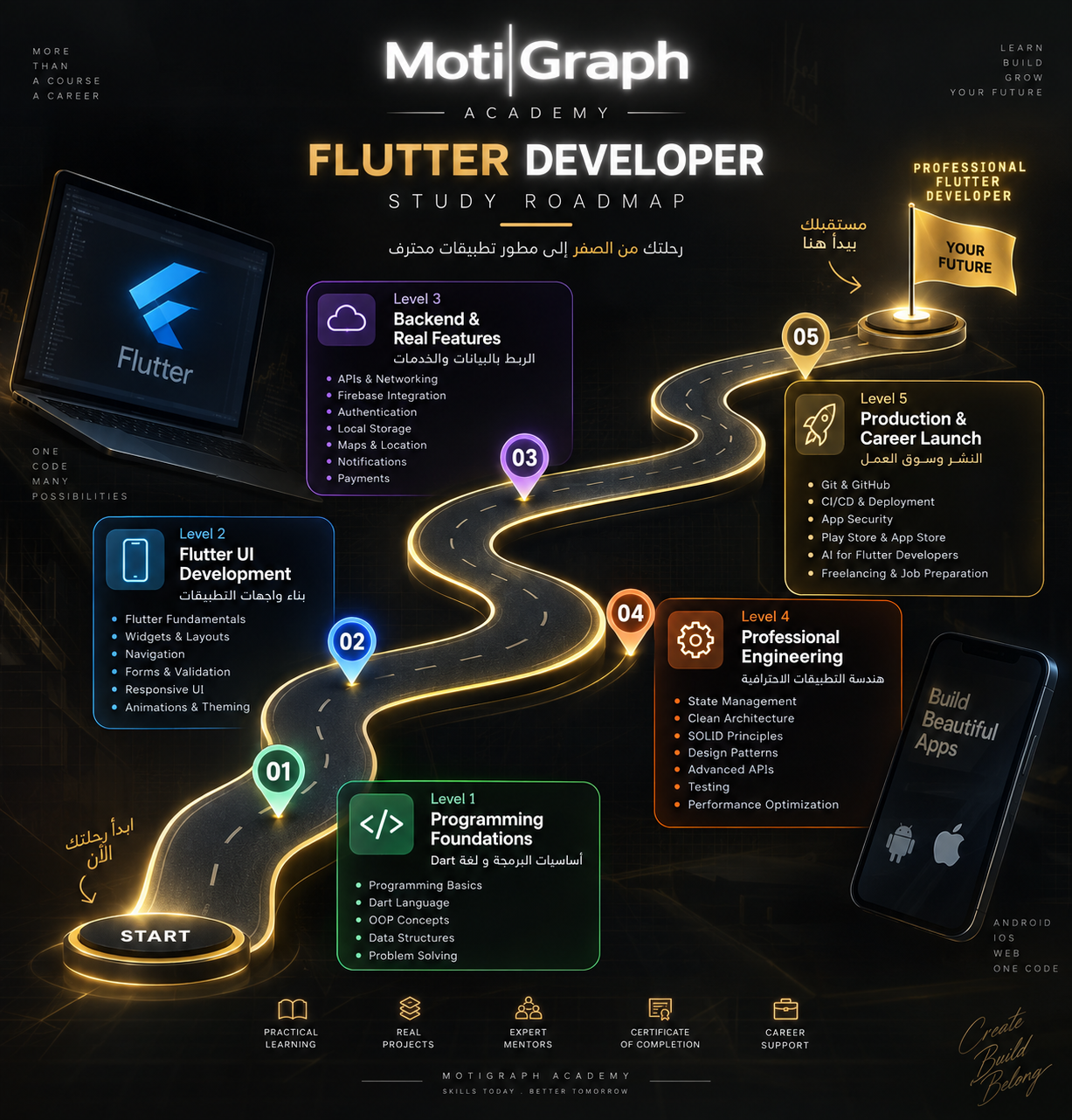
Course by Course
46 modules · 148 lessons. Open any module to see what is inside it.
-
01 Level 01 — Programming and Dart Programming Fundamentals
Before any language, how software actually works and how to think like a programmer: source code, compilers and runtime, variables and data, algorithms and logic, and breaking a problem down with pseudocode and flowcharts before you write a line.
- What is programming and how software works
- Source code, compiler and runtime
- Variables, data and algorithms
- Problem solving: pseudocode and flowcharts
- Logical thinking and debugging
-
02 Level 01 — Programming and Dart Dart Fundamentals
The language Flutter is built on. Setting up the Dart SDK and DartPad, project structure and running programs, then variables and constants, the core data types (String, int, double, bool, dynamic, var, final, const) and every operator group includin
- Dart SDK, DartPad and project structure
- Variables, constants and data types
- var, final and const
- Operators and null-aware operators
-
03 Level 01 — Programming and Dart Control Flow
Controlling the logic of a program: if, else, else if and switch, the for, while and do-while loops, break and continue, and nested conditions, applied to small practical exercises like login validation, an age calculator, a grade calculator and a si
- if, else, else if and switch
- for, while and do-while loops
- break, continue and nested conditions
- Exercises: validation, calculators, billing
-
04 Level 01 — Programming and Dart Functions
Structuring code into reusable functions: parameters (required, optional and named), return values, arrow functions, anonymous functions and callback functions, which you will meet everywhere in Flutter.
- Functions, parameters and return values
- Optional and named parameters
- Arrow, anonymous and callback functions
-
05 Level 01 — Programming and Dart Collections
Holding and transforming data: lists (create, add, remove, update, search), maps with key and value access, sets for unique values, and the functional operations that make Dart expressive: map, where, reduce, fold and forEach.
- Lists: create, add, remove, search
- Maps and sets
- Functional operations: map, where, reduce, fold
-
06 Level 01 — Programming and Dart Object-Oriented Programming
One of the most important parts of the whole diploma. Classes and objects, constructors and named constructors, properties and methods, getters and setters, then the four pillars: encapsulation, inheritance, polymorphism and abstraction, plus interfa
- Classes, objects and constructors
- Properties, methods, getters and setters
- Encapsulation and inheritance
- Polymorphism and abstraction
- Interfaces and mixins
-
07 Level 01 — Programming and Dart Advanced Dart
The Dart that professional Flutter relies on: null safety, enums, extensions and generics, exception handling with try and catch, and asynchronous programming with futures, async and await, streams and callbacks.
- Null safety, enums and extensions
- Generics and exception handling
- Futures, async and await
- Streams and callbacks
-
08 Level 01 — Programming and Dart Project: Personal Finance Manager
A console application that proves you understood programming and Dart before touching Flutter: manage income, expenses, categories and transactions, generate monthly reports, and search and filter records, all in clean, object-oriented Dart.
- Modelling accounts, categories and transactions
- Income, expenses and monthly reports
- Search, filtering and finishing the app
-
09 Level 02 — Flutter Development Flutter Environment
Getting a real Flutter workspace running: the Flutter SDK and CLI, VS Code, the Android emulator and iOS simulator, creating a project and understanding its structure, pubspec.yaml, packages, assets and fonts.
- Flutter SDK, CLI and VS Code
- Emulator, simulator and first project
- Project structure, pubspec, assets and fonts
-
10 Level 02 — Flutter Development Flutter Fundamentals
How Flutter actually works: the framework and engine, how Dart drives rendering, and the widget, element and render trees. Flutter follows a reactive UI model where widgets are the basic unit that the interface is assembled from.
- Flutter framework and engine
- Widget, element and render trees
- The reactive UI model
-
11 Level 02 — Flutter Development Widgets
The building blocks: core widgets (MaterialApp, Scaffold, AppBar, Text, Icon, Image, Container, SizedBox, Padding, Center), then stateful UI with StatelessWidget and StatefulWidget, State and setState, and the widget lifecycle.
- Core widgets: MaterialApp, Scaffold, AppBar
- Text, Image, Container, Padding, Center
- StatelessWidget vs StatefulWidget
- State, setState and the widget lifecycle
-
12 Level 02 — Flutter Development Layout System
Turning any design into a UI: Row, Column, Stack, Expanded, Flexible, Wrap, Align and Positioned, plus ListView, GridView and SingleChildScrollView. You also learn how Flutter layout really works: constraints go down, sizes go up, the parent sets pos
- Row, Column and Stack
- Expanded, Flexible, Wrap, Align, Positioned
- ListView, GridView and scrolling
- Constraints, size and position
-
13 Level 02 — Flutter Development User Interaction
Making screens respond: buttons, TextField, forms and validation, checkboxes, radio buttons, switches and dropdowns, date and time pickers, and dialogs and bottom sheets.
- Buttons, TextField and forms
- Validation, checkboxes, radios, switches
- Dropdowns, date and time pickers
- Dialogs and bottom sheets
-
14 Level 02 — Flutter Development Navigation
Moving between screens: the Navigator, routes and named routes, passing arguments and returning data, nested navigation and structuring navigation across a real app.
- Navigator, routes and named routes
- Passing arguments and returning data
- Nested navigation and structure
-
15 Level 02 — Flutter Development Professional UI
UI that looks and behaves professionally: themes, colors and typography, custom fonts, dark and light mode, reusable widgets and component design, RTL and Arabic localization, and responsive, adaptive layouts.
- Themes, colors and typography
- Custom fonts, dark and light mode
- Reusable widgets and component design
- RTL, Arabic localization and responsive design
-
16 Level 02 — Flutter Development Animation
Motion that feels right: AnimatedContainer and AnimatedOpacity, Hero animations, AnimationController with Tween and Curves, page transitions and small, purposeful micro animations.
- AnimatedContainer, AnimatedOpacity, Hero
- AnimationController, Tween and Curves
- Page transitions and micro animations
-
17 Level 02 — Flutter Development Project: E-Commerce Mobile App
A full shopping UI that exercises everything in this level: splash and onboarding, login and register, home, categories, products and product details, search, favourites, cart, checkout, profile and orders, all responsive and animated.
- Splash, onboarding, auth screens
- Home, categories, products and details
- Search, favourites, cart and checkout
- Profile, orders and final polish
-
18 Level 03 — Backend Integration APIs
How apps talk to servers: the client-server model, REST and HTTP, requests and responses, headers, parameters and query parameters, status codes, and the HTTP methods GET, POST, PUT, PATCH and DELETE.
- Client-server, REST and HTTP
- Requests, responses, headers, parameters
- Status codes and HTTP methods
-
19 Level 03 — Backend Integration JSON and Data Models
Turning raw API data into typed objects: JSON objects and arrays, parsing, serialization and deserialization, model classes, and mapping API responses onto them.
- JSON objects, arrays and parsing
- Serialization and deserialization
- Model classes and mapping API data
-
20 Level 03 — Backend Integration Networking in Flutter
Calling APIs the professional way: an HTTP client, an API service layer, request and response handling, and the loading, error and empty states plus a retry mechanism that a real app needs.
- HTTP client and API service layer
- Request and response handling
- Loading, error, empty states and retry
-
21 Level 03 — Backend Integration Authentication
Real user accounts: register, login and logout, authentication state, tokens and sessions, protected screens and password reset.
- Register, login and logout
- Authentication state, tokens and sessions
- Protected screens and password reset
-
22 Level 03 — Backend Integration Firebase
A full backend without writing one: Firebase Authentication (email/password and Google) and user sessions, Firestore with collections, documents, queries, CRUD and real-time updates, Firebase Storage for images and files, and Cloud Messaging for push
- Firebase Auth: email/password and Google
- Firestore: collections, documents, queries, CRUD
- Real-time updates
- Firebase Storage for images and files
- Cloud Messaging and push notifications
-
23 Level 03 — Backend Integration Local Storage
Keeping data on the device: shared preferences for local data, caching, secure storage for sensitive values, and the concepts behind offline support.
- Shared preferences and caching
- Secure storage and offline concepts
-
24 Level 03 — Backend Integration Maps and Location
Where the user is and what is near: location permissions, GPS and current location, Google Maps with markers and coordinates, distance, and live location tracking.
- Permissions, GPS and current location
- Google Maps, markers and coordinates
- Distance and live tracking
-
25 Level 03 — Backend Integration Payments
Taking money safely: the payment flow, checkout, the payment request and response, success and failure handling, and transaction state.
- Payment flow and checkout
- Request, response, success and failure
- Transaction state
-
26 Level 03 — Backend Integration Project: News Application
A real API-driven app: categories, search, article details and favourites, with proper loading and error handling throughout.
- API, categories and search
- Details, favourites and error handling
-
27 Level 03 — Backend Integration Project: Food Delivery Application
A complete real app on Firebase: authentication, restaurants and products, cart and orders, location, and push notifications, tying together everything in this level.
- Auth, restaurants and products
- Cart, checkout and orders
- Location, Firebase and notifications
-
28 Level 04 — Professional Engineering State Management
First why state management is needed at all, then local, shared and global state and the state lifecycle, then the tools: Provider and ChangeNotifier, and Bloc and Cubit, modelling loading, success, error, empty and initial states.
- Why state management, and its lifecycle
- Local, shared and global state
- Provider and ChangeNotifier
- Bloc and Cubit
- Modelling loading, success, error, empty
-
29 Level 04 — Professional Engineering Application Architecture
Structuring a project so it scales: feature-based architecture, separation of concerns, the UI, data and business-logic layers, and dependency management. Flutter guidance separates UI from data using views, view models, repositories and services, ad
- Feature-based structure and separation of concerns
- UI, data and business-logic layers
- Views, view models, repositories, services
-
30 Level 04 — Professional Engineering Clean Architecture
The presentation, domain and data layers, and what lives in each: entities and models, repositories and data sources, use cases and services, and dependency injection tying them together.
- Presentation, domain and data layers
- Entities, models, repositories, data sources
- Use cases, services and dependency injection
-
31 Level 04 — Professional Engineering SOLID Principles
The five principles: single responsibility, open/closed, Liskov substitution, interface segregation and dependency inversion. The goal is not memorising acronyms but knowing when to apply each so code is easier to change and test.
- Single responsibility and open/closed
- Liskov, interface segregation, dependency inversion
- Refactoring toward SOLID
-
32 Level 04 — Professional Engineering Design Patterns
Proven solutions to recurring problems: repository, factory, singleton, observer, strategy and adapter, and dependency injection as a pattern you apply deliberately.
- Repository, factory and singleton
- Observer, strategy and adapter
- Dependency injection as a pattern
-
33 Level 04 — Professional Engineering Advanced APIs
APIs at production scale: pagination and infinite scroll, search, filtering and sorting, caching and retry, handling network errors, and a repository layer that abstracts the API away from the UI.
- Pagination and infinite scroll
- Search, filtering and sorting
- Caching, retry and the repository layer
-
34 Level 04 — Professional Engineering Performance
Keeping an app smooth: understanding widget rebuilds and const widgets, lazy loading, list and image optimization, memory and network optimization, and profiling to measure rather than guess.
- Widget rebuilds and const widgets
- List, image, memory and network optimization
- Performance profiling
-
35 Level 04 — Professional Engineering Testing
Confidence to change code: unit testing for business logic, widget testing for UI components, and integration testing for the whole app flow, plus mocking, writing testable code, coverage and debugging.
- Unit testing business logic
- Widget testing UI components
- Integration testing and mocking
-
36 Level 04 — Professional Engineering Project: Streaming Platform
An engineered app, not just a UI: authentication, home, categories, search, details, favourites and watchlist, backed by an API with pagination, real state management, clean architecture, a local cache and tests.
- Auth, home, categories and search
- Details, favourites, watchlist and pagination
- Architecture, cache and tests
-
37 Level 05 — Production and Career Git and GitHub
Version control every team expects: repositories, commits, branches, merge and the basics of rebase, pull requests, issues and releases, and building a GitHub portfolio.
- Repositories, commits and branches
- Merge, rebase basics and pull requests
- Issues, releases and a GitHub portfolio
-
38 Level 05 — Production and Career Team Development
Working with others: a Git workflow, feature branches, code review and pull requests, resolving merge conflicts, team collaboration and documentation.
- Git workflow and feature branches
- Code review and merge conflicts
-
39 Level 05 — Production and Career Mobile Security Basics
Not leaving the door open: secure storage, API and authentication security, environment variables and secrets, Firebase rules, handling sensitive data and basic mobile security practices.
- Secure storage and sensitive data
- API, auth security, secrets and Firebase rules
-
40 Level 05 — Production and Career CI/CD
Automating builds and releases: build automation, development, staging and production builds, environment configuration, automated tests, CI/CD concepts and a release pipeline.
- Build automation and environments
- Automated tests and the release pipeline
-
41 Level 05 — Production and Career Android Deployment
Shipping to Google Play: app ID and versioning, signing and the keystore, the release build, APK and AAB, the Play Console, the store listing and a production release.
- App ID, versioning, signing and keystore
- APK, AAB, Play Console and release
-
42 Level 05 — Production and Career iOS Deployment
Shipping to the App Store: bundle identifier, certificates and provisioning, signing, the archive, TestFlight, App Store Connect and a production release.
- Bundle ID, certificates and provisioning
- Archive, TestFlight and App Store Connect
-
43 Level 05 — Production and Career Advanced Performance
Squeezing the last of it: startup optimization, rendering, memory and network, image caching, large lists, app size and deeper profiling.
- Startup, rendering, memory and network
- Image caching, large lists and app size
-
44 Level 05 — Production and Career AI for Flutter Developers
The goal is not AI writing the code for you, but using it as a development assistant: AI-assisted development, debugging, refactoring, code explanation, documentation and test generation, plus connecting apps to AI APIs.
- AI-assisted debugging, refactoring, docs and tests
- Connecting apps with AI APIs
-
45 Level 05 — Production and Career Career Preparation
Turning skill into a job: a Flutter developer CV and project presentation, a strong GitHub and LinkedIn, technical interview preparation across Dart, Flutter, OOP, state management, architecture, APIs and Firebase, and the basics of freelancing from
- CV, project presentation, GitHub and LinkedIn
- Technical interview preparation
- Freelancing: requirements, proposals, delivery
-
46 Level 05 — Production and Career Graduation Project: Ride-Hailing Application
The capstone: two connected apps. A customer app (registration, profile, map, current location and destination, ride request, driver matching, ride tracking, fare, payment, notifications, history and rating) and a driver app (profile, availability, r
- Planning, API, Firebase and data model
- Customer app: map, ride request and matching
- Customer app: tracking, fare, payment, rating
- Driver app: availability, requests and navigation
- Real-time data, notifications and testing
- Android and iOS release builds and documentation
Roles This Track Prepares You For
- Flutter Developer
- Mobile Application Developer
- Cross-Platform Developer
- Freelance Mobile Developer
Certificates You Can Earn
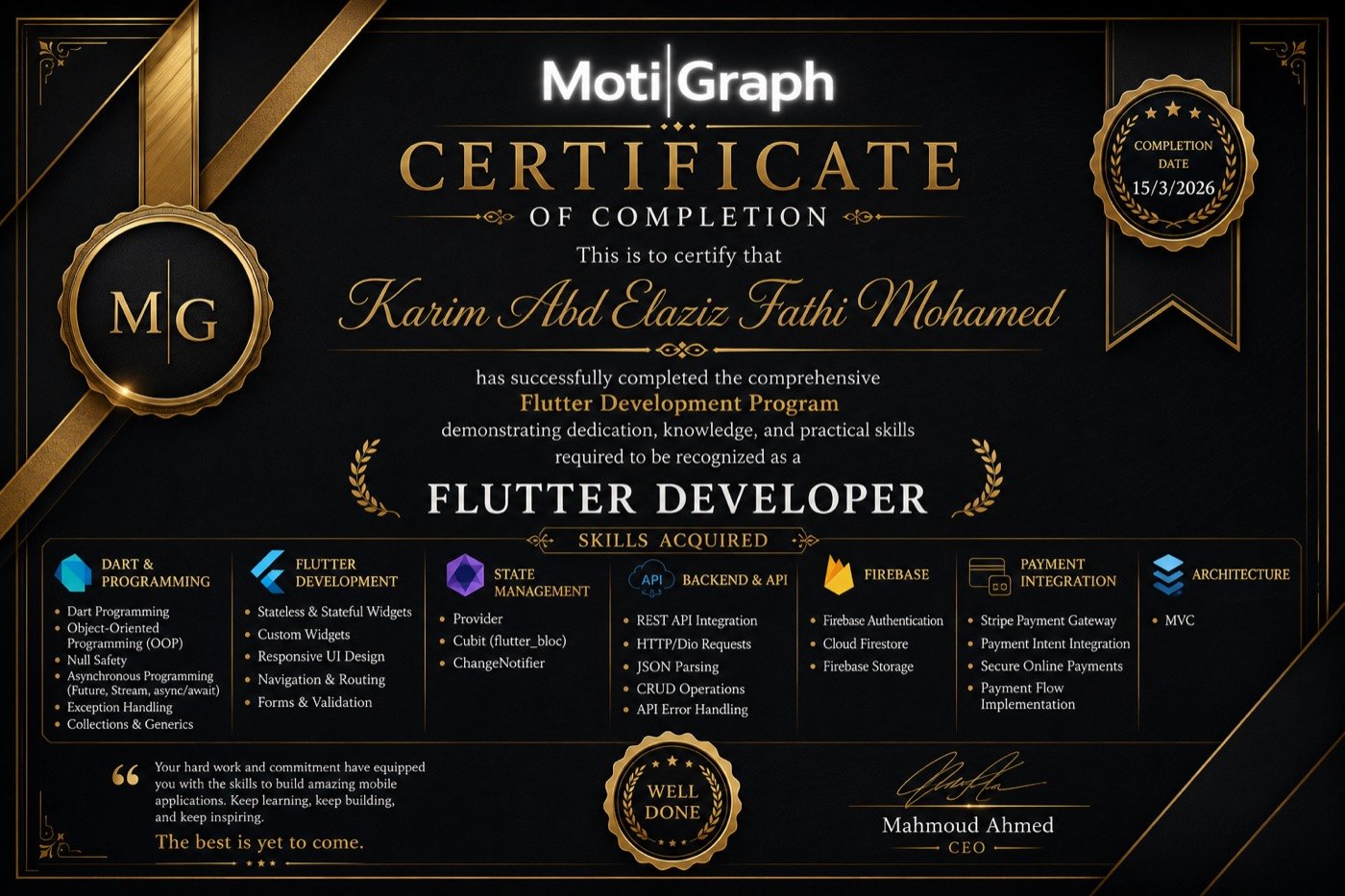
Finish your course and receive an accredited MotiGraph certificate you can add to your CV and share with employers.